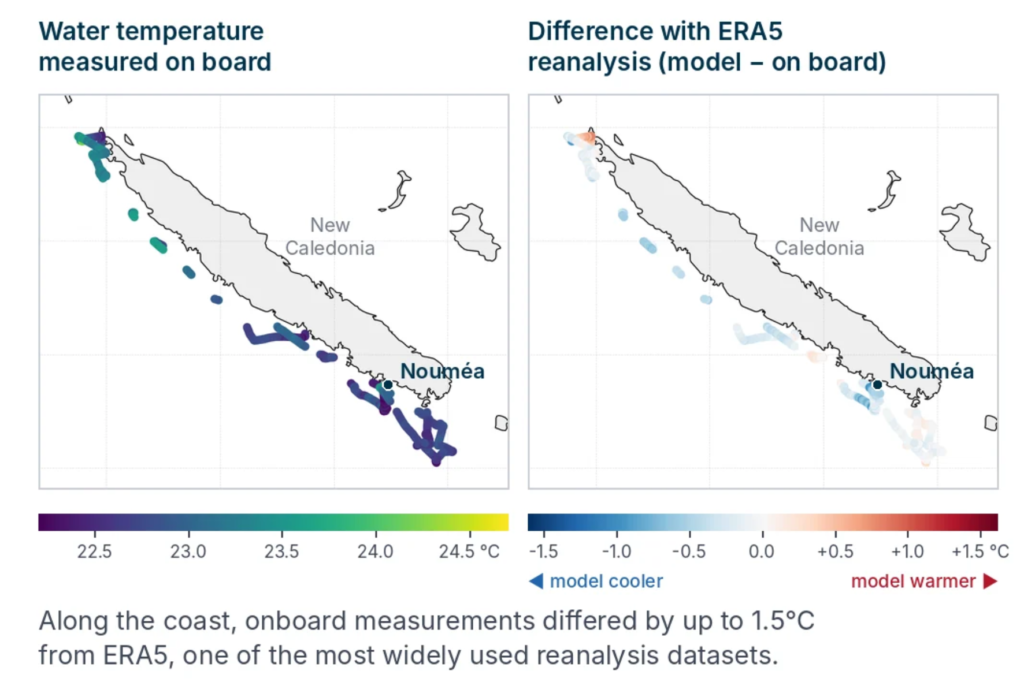
This El Niño could become one of the strongest on record. Tracking it requires observations at sea, and they are in short supply. In the Pacific, eight boats equipped by Oceano Vox measure water temperature as they sail. One of them recorded differences of up to 1.5°C with a reference model.
In early October, according to NOAA’s bulletin, sea surface temperatures were 4°C above normal in parts of the eastern equatorial Pacific. NOAA puts the odds at 83% that this event will exceed every one measured since 1950 by the end of the year.
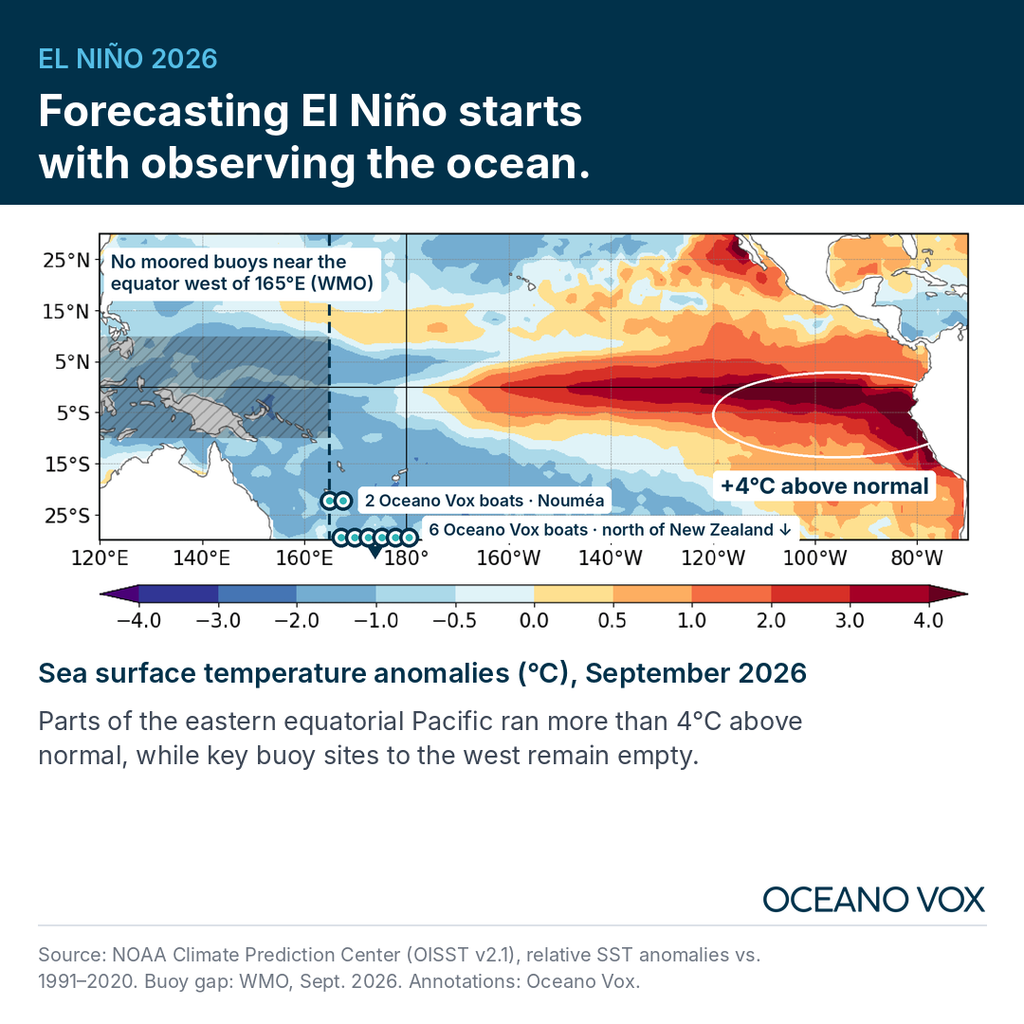
Monitoring and forecasting El Niño relies on measurements taken at sea. Yet there are no moored buoys left near the equator west of 165°E, in a region that helps shape El Niño. On 23 September 2026, at the UN, World Meteorological Organization Secretary-General Celeste Saulo put it plainly: without ocean observations, “we are flying blind.”
The 2026 Global Ocean Observing System (GOOS) Status Report reaches the same conclusion on a global scale. Progress is real, but significant gaps remain, particularly in polar regions, the Southern Ocean and many coastal areas.
More than 200 boats are equipped with Oceano Vox devices. They measure wind, atmospheric pressure and water temperature as they sail. Eight of them are currently in the Pacific: two in New Caledonia and six north of New Zealand.
Between 25 September and 25 October 2026, one of the boats in New Caledonia recorded water temperature along the south-west coast, around Nouméa. We compared these measurements with ERA5, the reanalysis produced by the European Copernicus programme and one of the most widely used in the world. The difference reaches up to 1.5°C, with the model most often cooler than the measurement.
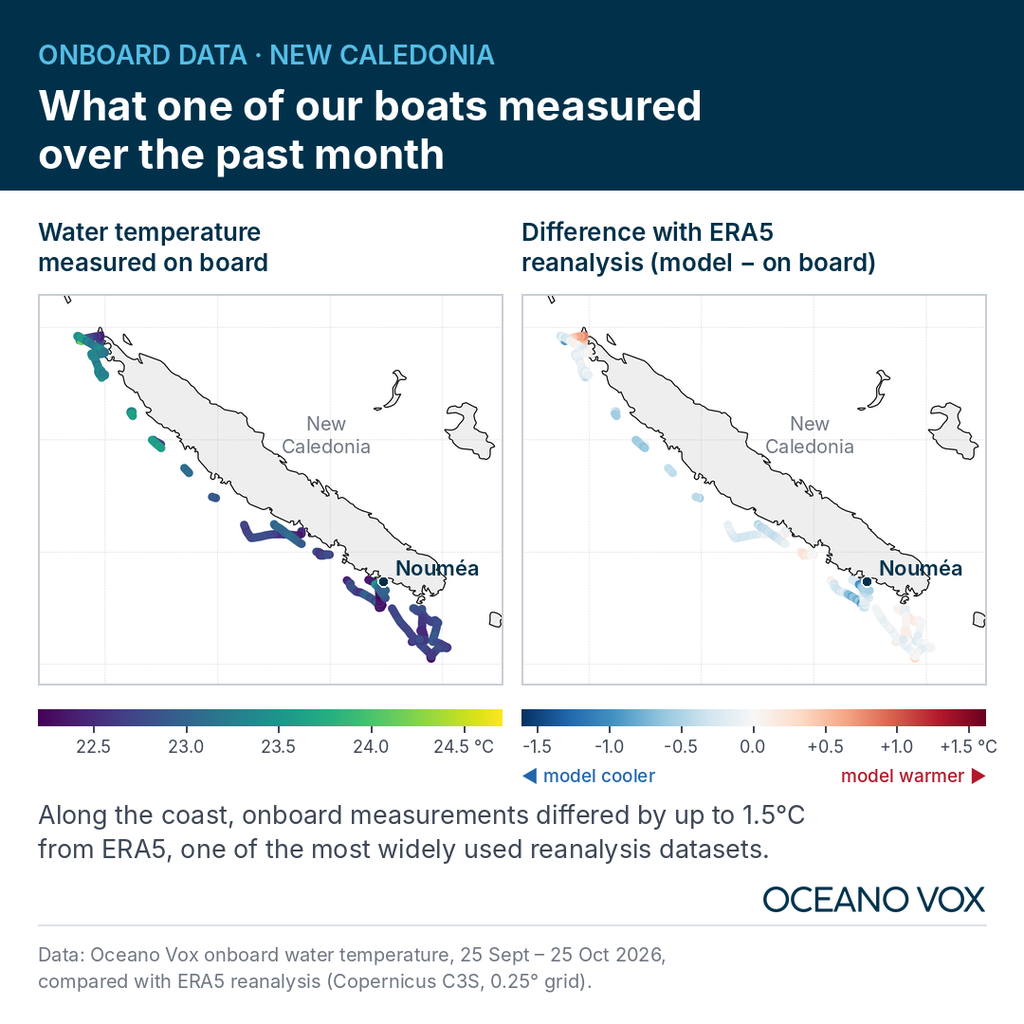
A likely explanation: ERA5 works on a grid of about 25 km, too coarse to capture conditions close to the coast accurately. That is precisely where onboard measurements add new information.
These observations are compared with forecasts in Weather Vox and shared with the scientific community. Eight boats do not replace a buoy network. But they show that boats already at sea can fill part of the gap, where measurements are scarce.
Sources: NOAA El Niño bulletin · WMO statement · GOOS 2026 Status Report